Showing posts with label Joseph Priestley House. Show all posts

Monday, June 23, 2025

Freeburg firm uncovering years of history during Joseph Priestley House restoration


As reported in The Daily Item, Sunbury, Pa. by

Marcia Moore,Mon, June 23, 2025 at 8:59 PM PDT


NORTHUMBERLAND — Owens Historic Preservation Services Ltd., of Freeburg, is in the midst of a four-month restoration project at Joseph Priestley House in Northumberland.

For company owner Bobbie Owens, the $145,000 project is more than a job.

“I went to school in Northumberland, and I was always over here,” she said, referring to the museum she and her crew are working in.

The project is a first for Owens, who has run her Snyder County-based business for 13 years mainly restoring exterior facades and windows on buildings in New Jersey, Massachusetts, Maryland and Philadelphia, including Historic Hope Lodge and Brandywine Battlefield historic site.

“I’ve never done an (extensive) interior project before,” she said as six workers toiled away, scraping off layers of paint with dental tools, heat guns and infrared strippers to unearth original woodwork on moldings, staircases and fireplaces and repairing plaster in several rooms of the building Joseph Priestley spent four years constructing as a home and laboratory between 1794 and 1798.

The English chemist, known for discovering oxygen, lived and worked there until his death at age 70 in 1804.

All of the home’s interior was locally sourced during construction, except for the ornate staircase which was built in Philadelphia, Owens said.

“We want to unveil the detail that’s been lost over the years. I love peeling back layers to reveal what was done years ago,” she said, pointing out the intricate detail put into the home more than two centuries ago. “We were not expecting the scallop detail in the dentil molding.”

Kevin Amey, a Cochranville furniture and wood restorer hired by Owens for the Priestley project, recognized the carved detail as “very English.”

Nearly all of the original work will be saved and restored, Owens said.

Building restoration was not always a career goal for Owens, who majored in English and history at Bucknell University. Following graduation in 2003, she worked with area counties serving children and families.

She relocated with her husband to Ipswitch, Massachusetts, where she responded to an “interesting description of a job” posted online by a start-up window restoration company run by Alison Hardy.

“I made a lot of mistakes and learned a lot,” said Owens, who volunteers with her former mentor on the Window Preservation Alliance while growing her own business that she started in 2012. “I love this because it uses my background in American history and English literature.”

In 2015, Owens was approved by the Pennsylvania Historical and Museum Commission (PHMC) as a specialty trades contractor.

PMHC is funding the $145,000 restoration of Joseph Priestley House, focusing on the library, dining room, parlor, hallways and a second floor bedroom. Much of the work has involved “painstakingly” removing decades of paint accumulation and “meticulously” repairing damaged plaster, PHMC Communications Director Jay Losiewicz said.

Following Priestley’s death in 1804, the home was privately owned until 1955 when the property was transferred to the borough of Northumberland. PHMC took ownership in 1965 and designated the home as a national historic landmark.

The interior hadn’t been painted in more than 40 years and no historic analysis of the paint had been done before the latest project, Losiewicz said.

Owens’ “diligent work has unveiled remarkable discoveries consistent with the Georgian era and hints of Victorian-era faux wood graining,” he said.

In a first-floor hallway, Owens discovered what is believed to be an original gray-green color on the walls. Each room is being painted with historically accurate shades of the gray-green as well as gold-beige and pale gray paint colors.

“This project will bring crispness and elegance back to architectural details, presenting visitors with an interior that largely mirrors its appearance during Priestley’s time, unseen for nearly two centuries,” Losiewicz said.

The restoration is expected to be finished in July, with the museum reopening soon after. Last year, Joseph Priestley House had 975 visitors during its 250th anniversary celebration of Priestley’s discovery of oxygen, operations manager Murrie Zlotziver said.


Monday, January 17, 2022

The House of Joseph Priestley

 The House of Joseph Priestley (reprinted from Science Magazine, November 27, 1919, p. 495)

The original house and laboratory of Dr. Joseph Priestley, the great chemist who discovered oxygen in 1774, and came twenty years later to America, which is located on the banks of the Susquehanna River, at Northumberland, Pa., was purchased recently by graduate students of the Pennsylvania State College, who plan to move it to the campus and make it a lasting memorial.

Upon learning that the Priestley homestead, which was built in 1794-1796, was to be put up at public auction, the Penn State chemists sent as their representative to the sale Dr. G. G. Pond, dean of the School of Natural Science at the college.  He was successful in making the purchase, and the historic mansion will be preserved.

Architects from the college will at once make the necessary surveys preparatory to the work of moving the Priestley house to the campus at State College. The house is of frame, and painting has kept the woodwork in a remarkable state of preservation, so that it may be possible to rebuild the greater part of the structure from the present lumber.  Immense pine timbers used in the framework are as good as new and the old-fashioned interior decorations -- arched doorways, fireplaces, and stairways -- are in such condition that they can be removed and replaced with comparative ease.

While the purchase of the house has been made by Dr. Pond for the Penn State chemistry alumni, who are scattered to all parts of the country, funds for its removal and erection on the college campus will be supplied by an as yet unnamed donor.  Actual work of removal will probably be started in the spring.  Northumberland is about sixty miles from State College, at the intersection of the north and west branches of the Susquehanna.

The reconstruction on the college campus will be along the old architectural lines, but modernized and adapted to some suitable use by the school of Natural Science, according to present plans.  The house is an old landmark in Northumberland county, and can be seen on the outskirts of the town from trains on the Pennsylvania Railroad passing Northumberland.  It is a two-story structure, with capacious attic space.  It is about 45 X  50 feet, with a projection at each end about 25 feet square.  One of those was the kitchen and the other the workshop, or laboratory, in which Priestley pursued his scientific study and experiments.

[Note:  The Priestley House was never moved from the original site in Northumberland county despite the best intentions of the alumni from Penn State.  However, the purchase did allow the Priestley House to be preserved-- Dr. Sliderule]

Tuesday, February 16, 2010

Senate Majority Leader Harry Reid Suggests Approach to Make Joseph Priestley House a National Historic Site

In a correspondence received on February 16, 2010, from Senate Majority Leader Harry Reid as a response to my correspondence about the Joseph Priestley House, Reid has suggested that parties interested in having the Joseph Priestley House and Museum considered as a National Historic Site within the National Park Service contact the Senators within whose district the site is located. In this case, interested parties should contact Senators Casey and Specter of Pennsylvania. He has also forwarded my correspondence to the two Senators.

I include the addresses, phone numbers, and email addresses of the two Senators below:

Senator Robert P. Casey Jr. (D-PA)
393 Russell Senate Office Building
Washington, D.C. 20510
Phone: (202) 224-6324
Toll Free: (866) 802-2833
Fax: (202) 228-0604

Senator Arlen Specter (D-PA)
711 Hart Senate Office Building
Washington , DC 20510
Main: 202-224-4254
Fax: 202-228-1229


Saturday, January 30, 2010

Correspondence from Tom Bresenhan about Joseph Priestley House and the National Park Service

I have now received a note from Tom Bresenhan, President of the Friends of Joseph Priestley House. I am encouraged by his confirmation that they will be speaking to the local congressional representatives about having the site evaluated by the National Park Service. The text of his note follows:

"Thanks for your note.

The Friends plan to conduct tours on weekend afternoons from mid-March to the end of November and special events such as Summer History Camp in July. We feel confident based on our experiences with tours and events in the fall of 2009. We expect to sign a Management Agreement with the PA Historical and Museum Commission in February which will continue state ownership and maintenance of the site as well as the utility bills. The Friends will be responsible for programming.

The Friends Board this year will be looking longer term, and your suggestion is one we will evaluate. I will contact our local Congressman's office to start the process with the National Park Service to evaluate the site and its circumstances.

As this moves forward we will keep in touch, through the newsletter and by email.

My sense now is, although the state's financial situation is precarious, it will improve this year leading to greater security in the PHMC [Pennsylvania Historical and Museum Commission] and more dependability in its relationships with management organizations. From this improved perspective we can then look toward the future with more certainty. This may lead to a greater role for the Park Service.

Thanks again for the note and your concern.

Tom Bresenhan"

Friday, January 22, 2010

Progress on Making The Joseph Priestley House Part of the National Park Service as a National Historic Site.

I have now received responses from both Senator Harry Reid and the National Park Service with regard to my suggestion to include The Joseph Priestley House as a National Historic Site as part of the National Park Service.
I include my latest letter to Senator Reid below and encourage all those of you who feel similarly to write to your congressmen supporting the idea.

Dear Senator Reid:
Thank you for having forwarded my email to you of Sept. 5, 2009 with regard to the Joseph Priestley House to the National Park Service. I have now received their response dated Nov. 5, 2009, and I note that they have copied you on that correspondence. I was encouraged to see that there is a way to proceed with the consideration of The Joseph Priestley House for inclusion as a National Historic Site in the National Park System. As indicated in that letter this is initiated through acts of Congress by first authorizing the NPS to conduct a special resource study.

I would like you to consider introducing legislation to authorize the NPS to conduct a special resource study as to whether the Joseph Priestley House is appropriate for inclusion in the NPS. I have read the pamphlet "Criteria for New National Parklands" that they included and I feel strongly that it meets the objectives set forth therein. I do not know what else I can provide you to help you move to the next step. I look forward to your suggestions.

Wednesday, December 2, 2009

Permanent Agreement between PA and Friends on Priestley House

On December 1, 2009 The Daily Item of Sunbury, PA reported that the Friends of Joseph Priestley House has come to a long term agreement with the Pennsylvania Historical and Museum Commission over the management and operation of the Joseph Priestley House and Museum in Northumberland PA. It is anticipated that the agreement will be signed shortly. Under the agreement the Friends will have complete control of the operation of the site. The state will continue to provide some of the cost to maintain the facility.

Tuesday, September 15, 2009

Letter to Governer Rendell about Joseph Priestley House

Dear Gov. Rendell:  

I would like to address the matter of the closing of the Joseph Priestley House in Northumberland, PA by the PA Historical and Museum Commission on August 14 of this year.  

While I am not a PA resident, I have followed with intense interest the developments this year. The site is a true national treasure and should be treated as such. I do understand the budgetary constraints that have plagued PA this year. I also do understand that the Friends of Joseph Priestley House are attempting to negotiate a way for them to operate the site. I think the Friends are a fine group (I am a member), but they do not have the real resources to do justice to the site.  

I propose, as an alternative, that you consider working with the U S Park Service to see if the site can be converted to a National Historic Site. If that were to occur, the site could be operated by the U S Park Service at no cost to the state of PA and still be made available to visitors. I know that the U S Park Service has just purchased the land for the memorial for United Flight 93 in PA, so there must be some discussions going on with the U S Park Service ongoing.  

This would be a wonderful compromise under the circumstances. It might even add additional tourism to PA if the site were made a National Historic Site of the U S Park Service since there are many people who want to tour U S Historic Sites (there are less than 100 such sites in the country). Thank you for your consideration of this proposal.

Wednesday, September 2, 2009

Joseph Priestley House Update

This blog continues comments and activities concerning the closing of Joseph Priestley House on August 14 and the various attempts to reopen it.  For continuity it is recommended that you start with the earliest post first. Please click on the label "Joseph Priestley House" at the left.

I have received three more correspondences on this topic:

The first was included in the "Postings from Priestley House" Newsletter of the Friends of Joseph Priestley House, Number 44, Summer 2009, which states:

"New Responsibilities Ahead for Friends
The friends Board is discussing a Management Agreement with PHMC [Pennsylvania Historical and Museums Commission] that could result in increased responsibilities for the Friends.
Ownership & Maintenance. PHMC will retain ownership of the site and cover major maintenance, exterior painting, electric, gas, water, sewer, and lawn care and snow removal.  The Friends would be responsible for the interior painting.
Insurance.  Friends will be responsible for liability insurance for anything conducted at the House (which we now have) as well as negligence insurance regarding the structures and contents (which we don't now have).  We may be responsible for the insurance for collections currently on loan from other sites.
Custodial Care. Friends would be responsible for custodial care of the facility -- that includes general housekeeping, light bulbs, toilet cleaning, etc.  A curatorial assistant would be available to respond to the injury or damage to artifacts.
Security.  Friends would be responsible to provide periodic security visits to [the]site and entrance for emergency responders and lock up after they leave.
Programming.  Friends are responsible for all events at the site including tours.  Special events at the site may include alcohol such as wedding receptions."

I have also received an email from: 
Amanda Shafer
Pennsylvania Historical and Museum Commission
Commonwealth Keystone Building
400 North Street, Plaza Level | Harrisburg, PA 17120-0053
Phone: 717.525.5368
Email: amshafer@state.pa.us
www.phmc.state.pa.us

"In the past years, the PHMC operated the Joseph Priestly House for about $140-160 thousand per year on a Wednesday through Sunday schedule. However, the cost to run the site in the future depends on many factors such as when the site is open, the number of programs held, maintenance and ticket/membership pricing.  While the Joseph Priestley house is temporarily closed, the PHMC is seeking other management options in order to keep the site protected and available to the public. Thank you for your interest in our sites. I have also forwarded your comments to the Executive staff."

The third correspondence is a letter from Congressman Dean Heller (R- Nevada)

"As you know , the National Park System owns and administers all of the current 86 National Historic Sites. Congressional legislation authorizes the Secretary of the Interior to designate an area of historical significance that is worthy of remembrance as a National Historic Site.  Current National Historical Sites include the home of Abraham Lincoln, the Vanderbilt Mansion, and the home and woodland property of John Muir.

I understand your admiration for Joseph Priestley's accomplishments. A famed philosopher, historian, and educator, he is most noted for his scientific achievements including the discovery of oxygen and nitrogen.  Throughout his lifetime, Joseph Priestley published more than 150 works on topics ranging from religion to electricity. You can be sure that I will keep your thoughts in mind should any legislation related to this topic come before the House of Representatives."


While I am not privy to the details of either the negotiations between the Friends and PHMC nor the line item costs for running Priestley House, the portion that Friends would be contributing would, I assume be less than the cost that PHMC would still be undertaking.

Surely, the U S Park Service would consider these costs to be a pittance compared to what they spend at their 86 other locations. They spent $9 Million this week alone to acquire the land they need to make the United Flight 93 National Historic Site Memorial in PA.  In spite of all the good intentions of all those involved, I still maintain that the National Historic Site alternative would be the best long term solution for the Joseph Priestley House.

Please contact the Secretary of the Interior and other government officials to express your opinion on this matter. Below is a copy of the body of my letter to Secretary Salazar:

Mr. Ken Salazar,

U.S. Secretary of the Interior

1849 C Street, NW

Washington, DC 20240


Dear Secretary Salazar:


On August 14, 2009, the State of Pennsylvania closed the Joseph Priestley House & Museum due to funding problems within the state.  The State owns the property and has a budget of about $150,000 a year to keep the site open.


While the Priestley House is recognized on the National Register of Historical Places, it is considered, by some, to be a true National Treasure.  The closing of the Priestley House is an immeasurable loss for our National Heritage. Please consider converting the Priestley House into a National Historic Site as part of the National Park Service so that it may be properly preserved and opened to the public once again.


Sincerely,


Dr. Sliderule


You may also want to contact:

Barbara Franco
Executive Director Pennsylvania Historical & Museum Commission
 State Museum Building
 300 North Street
 Harrisburg, PA 17120.

Make sure you read my previous blogs on this subject. Click on Joseph Priestley House on the labels to the left.


Monday, August 24, 2009

Joseph Priestley House Designation as a National Historic Landmark vs. National Register of Historic Places vs. National Historic Site

Definitions taken from Wikipedia:
 
A National Historic Landmark (NHL) is a building, site, structure, object, or district, that is officially recognized by the United States government for its historical significance. All NHLs are listed in theNational Register of Historic Places. Out of more than 80,000 places on the National Register, however, only about 2,430 are NHLs.  [NHLs are not owned by the Federal Government (this is my comment)]

The National Register of Historic Places (National Register) is the United States government's official list of districts, sites, buildings, structures, and objects deemed worthy of preservation. Having a property on the National Register makes its owners eligible for tax incentives for expenses incurred preserving the property if they are offered by the local taxing districts.

National Historic Sites are Federally owned and administered [lands]. Some other Federally administered sites are National Historical Parks. There are also about 79,000+ National Register of Historic Places sites, which usually are privately owned, of which about 2400 have further been designated as National Historic Landmark sites.

Joseph Priestley House is owned by the State of Pennsylvania. Consequently, it is not a National Historic Site. It has been designated a National Historic Landmark. 

Now that the Joseph Priestley House has been closed by the State of Pennsylvania I would like to see that the designation for Joseph Priestley House be changed to that of National Historic Site and that the ownership be ceded to the Federal Government to insure that the site is opened to the public and funded at an appropriate level.


The following email was sent to the Department of the Interior today
To: feedback@ios.doi.gov
Gentlemen:

The Joseph Priestley House in Northumberland PA was closed on August 14, 2009 by the State of Pennsylvania due to budget cuts.

While I understand that Priestley House is owned by the State of Pennsylvania and is designated a National Historic Landmark by the U.S. Park Service, I can only emphasize that this site is a true national treasure and should be designated a National Historic Site.  With that status the U.S. Park Service could provide the support necessary to reopen the House and Museum and make it available once again to the public.

The importance of Joseph Priestley as a part of the national heritage of this country cannot be left to a distant memory. It must be protected and promoted in a manner that only the U.S. Park Service can perform.

Joseph Priestley has already been honored with a U.S. Commemorative Stamp in his honor.  His connection to our founding fathers is profound and his contribution to what we are as a nation is undisputed.

Thank you for your attention.

Wednesday, August 19, 2009

The Latest Proposal on Saving the Priestley House

According to Jan Bowman, Northumberland Borough Secretary, "The Borough Council met last evening [August 18, 2009] with Tom Bresenhan, Co-President of the Friends of the Joseph Priestley House.  This group is negotiating with the State to be permitted to open the Priestley House with volunteers giving tours." 

While I commend both the Borough of Northumberland and the Friends of the Joseph Priestley House for their efforts, this can only be a stopgap effort.  Clearly, the upkeep and development of the site needs full-time skilled professionals that can only be accomplished with sufficient funding. I still feel that making Joseph Priestley House a National Historic Site under the administration of the U.S. Park Service is the only way to insure that the site is properly protected.

According to Mr. Bresenhan the Priestley House already carries the designation of National Historic Landmark (January,.1965) of the U.S. Park Service.

My only real experience with National Historic Sites of the U.S. Park Service is with Weir Farm in Ridgefield, CT. Until Weir Farm was established there were no National Historic Sites or Parks within the state of CT. Once designated, the U.S. Park Service came in with money to provide much of the infrastructure changes needed to handle the staffing, traffic, land acquisition, etc. to bring it up to the standards that they have for any site. I was very impressed with what they did. They did not come in with big bulldozers, so to speak. They  were very sensitive to the needs of the community and the history of the site.

I don't know what the difference between a National Historic Site and National Historic Landmark, but I will investigate this, and I'll bet that it is in that difference that we will find out why the U.S. Park Service has not been as actively involved in the Priestley House.

Monday, August 17, 2009

Further Thoughts About the Closing of Joseph Priestley House

The stamp to the left, which is based upon a painting by Dennis Lyall, of Norwalk, CT, was issued by the United States Postal Service on April 13, 1983 in Northumberland, PA to commemorate the 250th anniversary of Joseph Priestley's birth.  Lyall based his painting of Priestley on an 1801 portrait of Priestley by Rembrandt Peale which is located in the Philosophical Society Library in Philadelphia, PA.

Priestley and his wife, Mary, had settled in Northumberland PA, after immigrating to the United States in 1794 from England.  From 1795 to 1797 they built their house there. Unfortunately, Mary died before the house was completed. Until its closing last week on August 14, the Joseph Priestley House, which is owned by the Pennsylvania Historical and Museum Commission, had operated as a museum in his honor.  There was a special ceremony at the Priestley House on the day the commemorative stamp was issued.

Joseph Priestley, of course, was the first of a long list of  emigrant scientists celebre to come to the United States to partake of the freedom and liberty enjoyed by our citizens. Priestley was the noted chemist, biologist, theologian, political activist, and educator who had fled England with his family after the Birmingham Riots of 1791 where his house, laboratory and church were burned to the ground in protest of his support of the French and American Revolutions. 

Among other notable accomplishments, Priestley was known for his scientific work in discovering oxygen, nitrogen, ammonia, nitrous oxide (laughing gas), and 5 other gases. He also invented the first method of artificially creating carbonated water or "soda water".  He, additionally, was the first to note that there was a gas cycle wherein plants and animals produced oxygen and carbon dioxide, respectively, to symbiotically support the survival of the other. He wrote the definitive text on electricity which was considered the standard text on the subject for about a century.

Priestley's political writings have been credited as providing Thomas Jefferson with key concepts relative to his expressions of liberty and freedom that are found in the Declaration of Independence. He was a close friend of Benjamin Franklin and corresponded regularly and met with many of the other American Founding Fathers. He was an abolitionist, and a strong supporter of tolerance and equal rights for all. Some have referred to him as the "high priest" of our Founding Fathers.

He was a dissenting minister and wrote many scholarly texts on the history of the Christian Church.  He cofounded Unitarianism in England  also brought that Church to the United States. 

Priestley was an educator and wrote books on various subjects including grammar, history, etc. and developed pedagogical tools that are still in use today.  In fact, he wrote over 150 books which were on a wide diversity of subjects and he believed in the open and free exchange of information for all human endeavors.

While the Priestley House is recognized on the National Register of Historical Places, it is considered, by some, to be a true National Treasure.  The closing of the Priestley House last week is an immeasurable loss for our National Heritage. Please contact your congressional representatives to have them consider converting the Priestley House into a National Historic Site as part of the National Park Service so that it may be properly preserved and opened to the public once again.

Friday, August 14, 2009

State of Pennsylvania Closes the Joseph Priestley House in Northumberland


It was with great sadness that I learned today that the State of Pennsylvania closed the Joseph Priestley House.  As reported by News Radio WKOK:


Friday, August 14, 2009

Pennsylvania closes the Joseph Priestley House in Northumberland

NORTHUMBERLAND – The Joseph Priestley House in Northumberland closed its doors at 3:00  p.m. today.  Co-president of the Friends of the Joseph Priestley House, Tom Bresenhan, tells us the state made the announcement Thursday.  He says they were told the museum would close and their director Andrea Bashore, would be furloughed.  Bresenhan says they hope the closure will be a temporary one.  The Friends of the Joseph Priestley House has submitted a plan to the state to continue to keep the sight open on a limited basis.  Probably on afternoons and weekends, they hope to have volunteers operating the site, with the facility still owned by the state. 

Bresenhan says they were expecting this step to be taken by the state, with no budget passed and four of the six identified sites, including the Priestley House closed their doors today.  (Ali Stevens) 

If you would like some additional information on the Priestley House you may click on the Joseph Priestley House Index Tab on the left side of this page.

Sunday, July 26, 2009

Commemoration of the 200th Anniversary of Joseph Priestley's Death


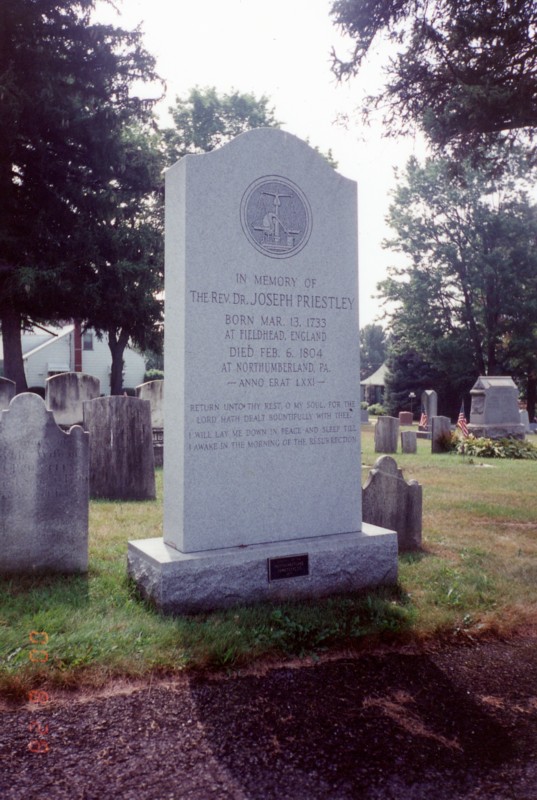
Joseph Priestley died on February 6, 1804 at his home in Northumberland, PA.  My wife and I, having long admired this extraordinary individual, traveled to Northumberland from Connecticut on February 5, 2004 to pay our respects to him the following day on the 200th anniversary of his death.


 He is buried in the Riverview Cemetery quite near his home there.  It was still wintertime and quite a bit of  snow was on the ground.  We visited the Priestley House, went to his graveside nearby, and went to the Priestley Memorial Chapel of the Unitarian Church in Northumberland for a special service in his honor that Sunday.  He is buried with a simple headstone with his wife, Mary, at his side. His headstone reads:
       "Return unto thy rest, O my soul, for the


Lord hath dealt bountifully with thee.
I will lay me down in peace and sleep till
I awake in the morning of the resurrection"


There were no other visitors at the House or the cemetery that weekend.  Except for the scaled down staff at the House most people who have any interest in Priestley were paying their respects to him in Leeds, England. The place of his birth. I thought that a bit odd, but no matter where it was, it was an awesome occasion. We were quite impressed with the level to which his house had been restored to its original condition.  The staff were incredibly well versed in the history and significance of the site and offered every amenity of cordiality to us.  The service at the Priestley Chapel was inspiring.  The Unitarian Minister from Philadelphia gave the sermon to a packed house which was a well rounded account of Priestley's life and the extraordinary contributions that he made to civilization.  That was the first time I have heard of Priestley referred to as "Gunpowder Joe", a reference to his explosive involvement with the political issues of the time when he was in Birmingham.

It was at Priestley House on August 31 through July 1, 1874, that a group 75 chemists made a pilgrimage to celebrate the centennial of chemistry.  This was the date chosen to mark the 100th anniversary of the date that Priestley performed the experiment that produced oxygen by heating mercuric oxide with sunlight using a "burning glass", a device made of lenses to concentrate the sun's light. The meeting in 1874 is recognized as the first National Chemistry Congress and led to the formation of the American Chemical Society.

We can highly recommend a pilgrimage to this site if you have the opportunity. It is awesome.