Showing posts with label Matthew Boulton. Show all posts

Sunday, October 11, 2015

Joseph Priestley is on the Move Again

Bronze Sculpture of Joseph Priestley, Leeds, England. Walter Harding, sculptor, 1903

In an article in the Birmingham Mail it has been reported that the bronze statue of Joseph Priestley in Chamberlain Square is on the move.  The statue has been removed from its plinth and transported into storage at the Birmingham Museums Trust Collection Centre ahead of the demolition of the Central Library and the start of reconstruction of the area around the Square.  The statue of James Watt was also removed and the statue of Thomas Atwood will also be removed in a similar manner.
They will all be returned to the Square when the construction work is completed.

Both Watt and Priestley resided in Birmingham during the early days of of the Industrial Revolution and were members of the Lunar Society.  Priestley, a clergyman, scientist, educator, and social activist is best known for his discovery of Oxygen.  James Watt and Matthew Boulton are credited with the development of the steam engine.

The Joseph Priestley Statue was originally located in Victoria Square, then called Council House Square, but was later move to Chamberlain Square and recast in bronze due to irreparable weather erosion to the original marble.
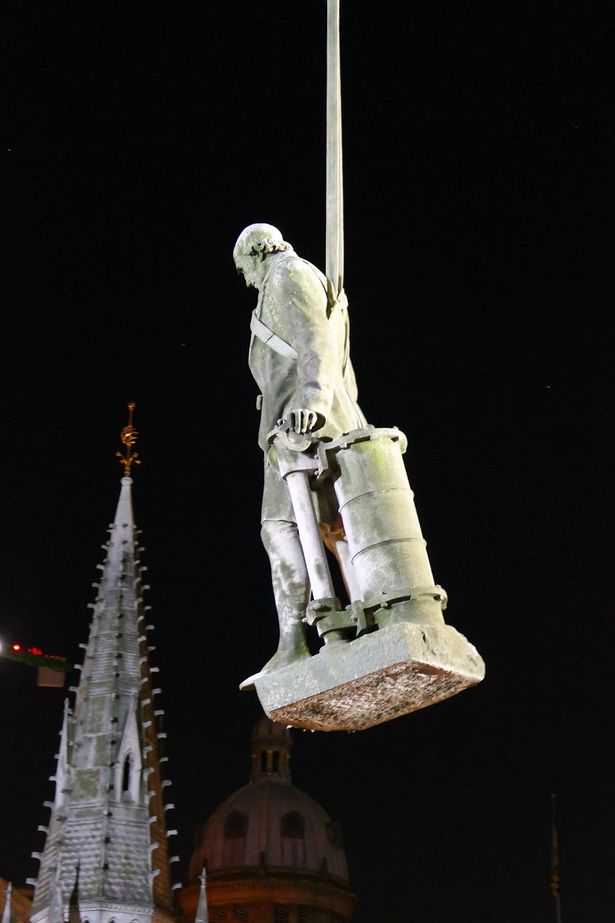
Watt on the move

Monday, July 27, 2009

Dr. Priestley's Slide Rule

I mused about whether Joseph Priestley, eminent natural philosopher that he was, ever had a slide rule.  While I was at the Priestley House in 2004, I asked the docent, Brooke Dearman, if they had any information to that effect.  Wouldn't you know, the following day she informed me that on the Inventory of Dr. Priestley's Laboratory in 1791 was the listing of a slide rule.  Just in case you don't remember, this is the very same Laboratory that was burned to the ground during the Birmingham Riots of the same year. So, in fact, this is a list of the items that were destroyed when the Laboratory was destroyed.

This Inventory appeared first in the Birmingham Weekly Post in 1890, and was subsequently reprinted as an Appendix in Scientific Correspondence of Joseph Priestley by Henry Carrington Boulton in 1892, and then reprinted again in the reprinting of Boulton's book by the Kraus Reprint Co., New York, in 1969. I've referred to this book before. If you are seriously interested in studying about Priestley, it is a good book to have for reference.

There it is on page 229 under the category of Mathematical Instruments, "A Sliding Rule of the best construction" and on the next line "A Navigation Sliding Rule".  So, now we know that he had two "Sliding Rules". 

But, is there anything else we can learn or conjecture about these sliding rules.  During this period of time, from 1780 to 1790, Matthew Boulton, the famous engineer and industrialist,and his partner of James Watt,  who were both friends of Priestley's and also members of the Lunar Society, had produced a "Sliding Rule" at their Soho Manufactory called a "Soho" ruler in about 1775. This was specifically designed for the engineers' use at Soho. James Watt, earlier in his career was a scientific instrument maker and was quite familiar with the sliding rule.  As best as I can tell at this time the Soho sliding rule had A B C D scales, the  A B and C  scales were double decade scales so that squares and square roots could be computed rapidly, and the D scale was a linear scale. 
There also appear to have been some French slide rules being produced at this time also.

So, it is not clear which exact type of sliding rules Priestley had in his Laboratory. He certainly had access to the Soho sliding rules through Boulton and Watt.  Additionally, we know that Boulton supplied many other instruments and items of need to Priestley's laboratory.  Any information on this would be greatly appreciated.


Saturday, July 25, 2009

Joseph Priestley Engraving by W. Holl


The next image of Priestley that I have in my collection is an engraving by W. Holl. This is one of my favorites. It hangs, framed, in a very prominent place in my office.

It is 13.2 cm by 10.6 cm. This is a steel engraving attributed to a picture by Gilbert Stewart [sic.] in the possession of J. B. Barclay, Esq. of Liverpool. Under the Superintendence of the Society for the Diffusion of Useful Knowledge. London. Published by Charles Knight, Ludgate Street & Pall Mall, East. 1833.

I should mention that a very complete list of the likenesses of Priestley from before 1891 can be found in an Appendix to Scientific Correspondence of Joseph Priestley, edited with copious biographical, bibliographical, and explanatory notes by Henry Carrington Bolton, Privately Printed, New York, 1892.  I am fortunate to have the not so rare Kraus Reprint of 1969 of the rare 1892 first edition. 

In any case, this engraving is identified as (29) on page 179 of that list.  The history of the Gilbert Stuart painting is very interesting in its own right. That will be for another post. I might also annotate here the Bolton number of the other likenesses I have already posted where they exist. I have modified the Bolton nomenclature to account for subsequent likenesses appearing after 1892: Wedgwood medallion (49) as first issued in about 1769, sculpted by Flaxmann (I refer to mine as (49.1) since it is a later edition of the same mold). Please note that there were two different sizes of (49). The one I have is the smaller one. The Halliday medallions are listed as (86) and make no distinction between the bronze and block-tin varieties. I see no mention of the P Bemi medallion.  There were many likenesses of the Wedgwood medallion made. There is no question in my mind that the Bemi medallion is a copy of the Wedgwood medallion. I will reserve assigning a Bolton number to this medallion at this time. It might be time to reconsider the whole numbering system.